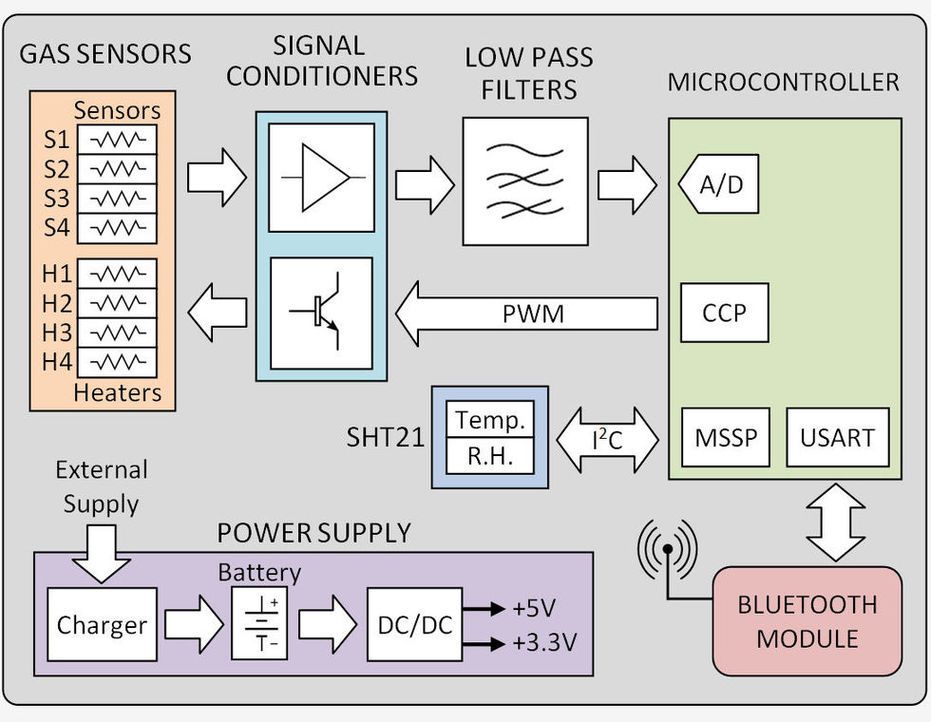
A new miniaturized electronic nose (60x60 mm) connected to a smartphone through Bluetooth connection that was presented in this conference has an electronic design similar to other prototypes, but with a smaller size and consumption. The control of the system is based on a microcontroller PIC18F46K80. It includes four miniaturized MOX sensors and an integrated sensor of ambient temperature and humidity with suitable conditioning circuits.
Communications with the smartphone are made using a Low Power Bluetooth Transmitter. An Android application has also been developed to connect to the device and to monitor the measurements. Data processing is performed remotely on a server by sending a request to it and subsequently receiving the output value of a classifier based on neural networks or fuzzy logic calculated on the server.
Jesús Lozano1*, Patricia Arroyo1, José Ignacio Suárez1, José Luis Herrero1, José Pedro Santos2, Manuel Aleixandre2
1 Escuela de Ingenierías industriales. Universidad de Extremadura, Av. Elvas s/n, 06006 Badajoz, Spain.
2 GRIDSEN Instituto de Tecnologías Físicas y de la Información (ITEFI-CSIC), Serrano 144, 28006 Madrid, Spain.
* jesuslozano@unex.es
 The Interlaboratory Comparison for Olfactometry (ILC) based on the Standard EN 13725:2003 has been announced for this year 2018 and once again the company Olfasense is behind the organization. The registration period has started!
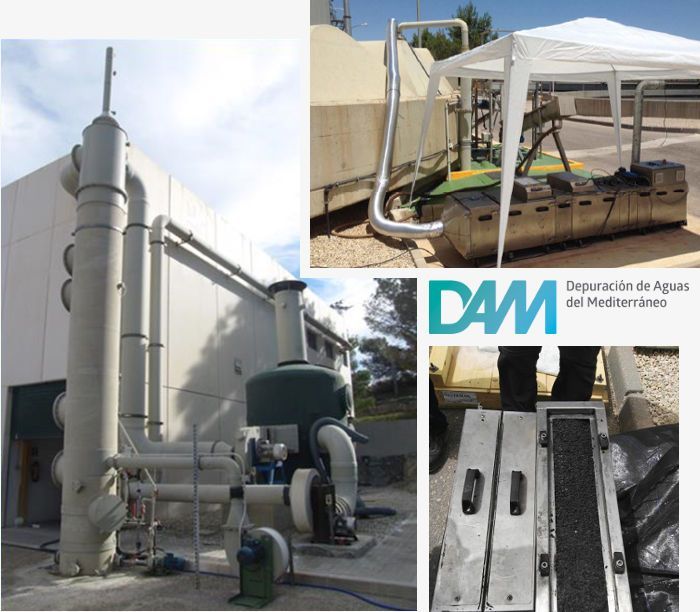 The generation of odours in a WWTP is usually caused by the presence of hydrogen sulphide (H2S). This gas, moreover, is responsible for the deterioration of the facilities’ materials and involves a health hazard for plant operators. Currently there are several alternatives that allow decreasing the impact of odours associated with H2S.