There is no translation available.

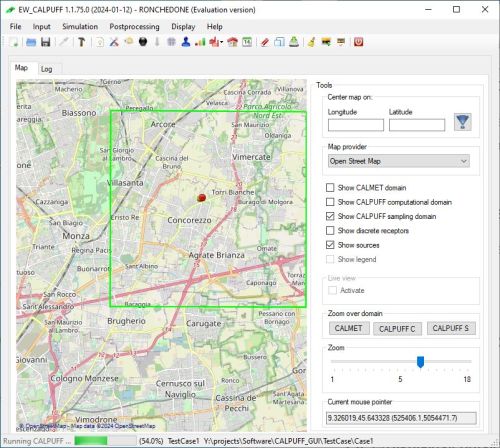
  Enviroware, an Italian company specialised in air quality consulting, has released version 7.2.1 of its EW_CALPUFF, a graphical user interface (GUI) dedicated to easily manage the Lagrangian puff model CALPUFF, widely used in atmospheric dispersion modelling for pollutants and odours.

  If you work with odour modelling, you are probably familiar with the dispersion model CALPUFF. This is a propietary, source-available (not open-source) non-steady-state Lagrangian puff model used to simulate pollutant transport, transformation, and deposition, taking into account time- and space-varying meteorological conditions. The official proprietary software (not open-source) CALPUFF core models (CALMET, CALPUFF, and CALPOST) are free to download and can be run via the command line, although the GUI requires a paid licence. In the past, there were several other GUIs available, such as CALPro, CALApps, Beeline, or MMS-CALPUFF but most of these have now been discontinued. Another well-known GUI is this one of the Italian company Enviroware that has been recently updated. This release introduces two new features.
There is no translation available.

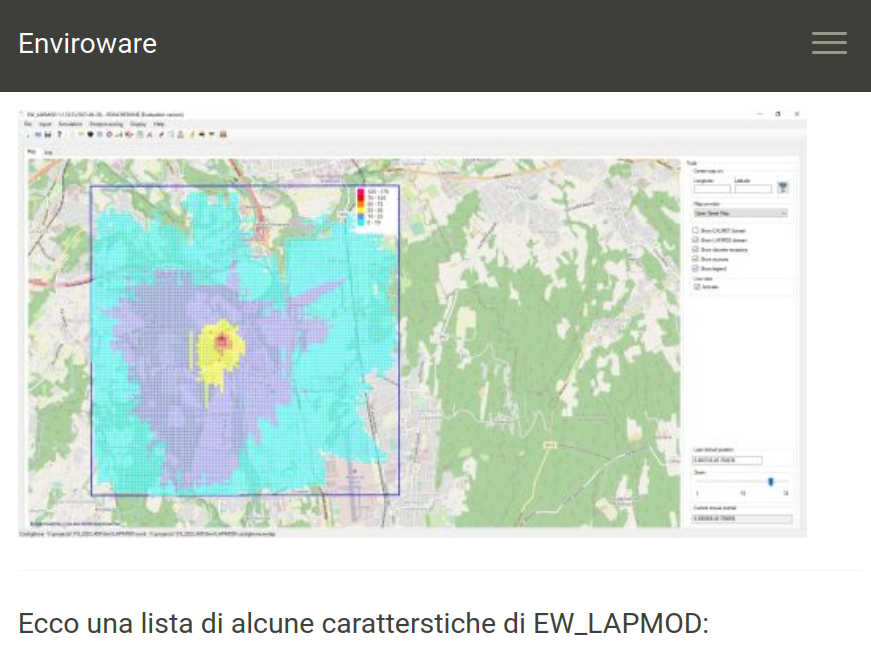
   The Italian company Enviroware is just on fire. They recently released an update of their CALPUFF GUI and also they published an update of their well-known model LAPMOD.  EW_LAPMOD is a graphical User Interface (GUI) designed for the Lagrangian particle model LAPMOD, an open-source tool used for simulating the dispersion of atmospheric pollutants. The software operates on Windows systems (we, linux users, will be missing it) and aims to simplify both the preparation of model inputs and the analysis of outputs generated by LAPMOD.

   Enviroware has released a new update to the official GUI for the propietary, source-available (not open-source) Lagrangian particle model LAPMOD, featuring two major new features:  

There is no translation available.

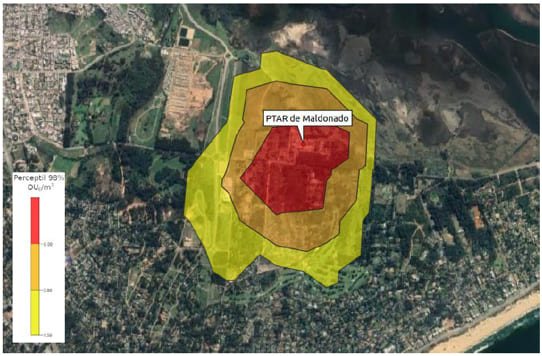
   The Jagüel Wastewater Treatment Plant in Punta del Este, Uruguay, underwent an odor control improvement plan ahead of a major renovation.

    A study by Ambiente et Odora measured H₂S emissions, modeled odor dispersion with CALPUFF, and identified key sources. Corrective actions included improved ventilation in centrifuge rooms, replacement of biofilters with granular activated carbon filters, and dosing ferric chloride into the slurry. These measures effectively reduced odors during the summer season, with no reported complaints.

A. Irigoyen*1, D. Berger1, A. Anton2, & C. Diaz2

1CIEMSA

2Ambiente et Odora

Plus d'articles...

All the content here under Creative Commons license