There is no translation available.
49 004

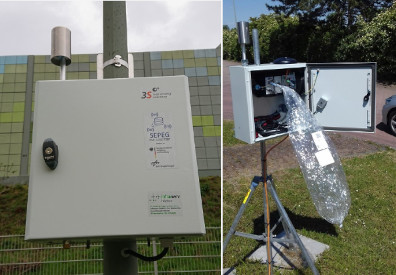
   Instrumental Odour Monitoring Systems (IOMS) are employed for continuous objectified technical olfaction. However, the reference for odour perception is the human nose, surpassing technology with outstanding sensitivity and selectivity for many compounds. In order to achieve comparable results, IOMS have to fulfil manifold requirements, resulting in considerable effort in engineering and cost. One-size-fits-all solutions are unlikely to function properly but are nevertheless marketed as the resulting performance is difficult to assess.

   In the course of the publicly funded research project SEPEG (sensor networks for the objective perception of odour sources, BMBF FKZ 01IS17087) all aspects of a complete IOMS solution are scrutinized in their respective context. A main focus of the project is on field test evaluation in real installation situations. Two installation sites have been equipped with networks of real-time IOMS devices.
There is no translation available.

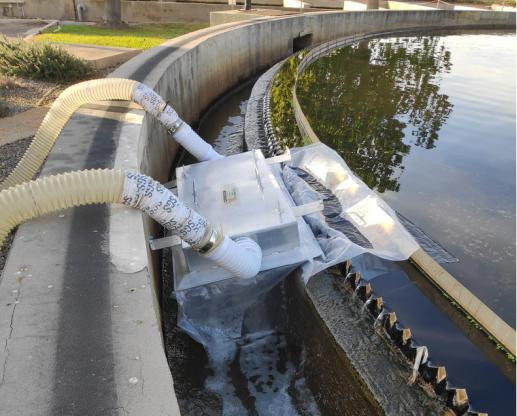
27 3   During the last years, there is a need to plan strategical investments to reduce Wastewater Treatment Plant (WWTP) odour impact, which it is generally carried out by covering and deodourizing the main process units involved.

   Odour dispersion modelling software combined to dynamic olfactometry is the standard technique conducted to evaluate the odour impact studies. However, the results obtained by this methodology strongly depend on the emission sources set in the software. Thus, this study is focused on providing a dynamic odour impact assessment using CALPUFF software simulations, calculated under different “what-if” scenarios, providing a new approach to define the calibration of the emission sources.

There is no translation available.

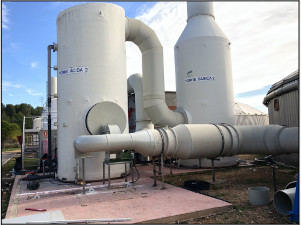
42 003   The wastewater treatment plant (WWTP) of Torredembarra, located in the province of Tarragona, Spain, has suffered for years from noticeable odor emission problems, mostly during the summer season. During past years, the odor treatment in the WWTP relied on a series of biological and physico-chemical systems, which led to significant operating costs and which had fluctuating efficiency, mostly during summer season.

   In order to mitigate these odor emission events, a comprehensive restructuring plan was developed for this whole treatment system. The emission rates of the main odorous compounds in all the critical points of the WWTP were assessed during different times of the year. The most relevant odour emission areas were then confined, and the headspace air treated in a series of new and retrofitted biotrickling filters.

Altri articoli …

All the content here under Creative Commons license