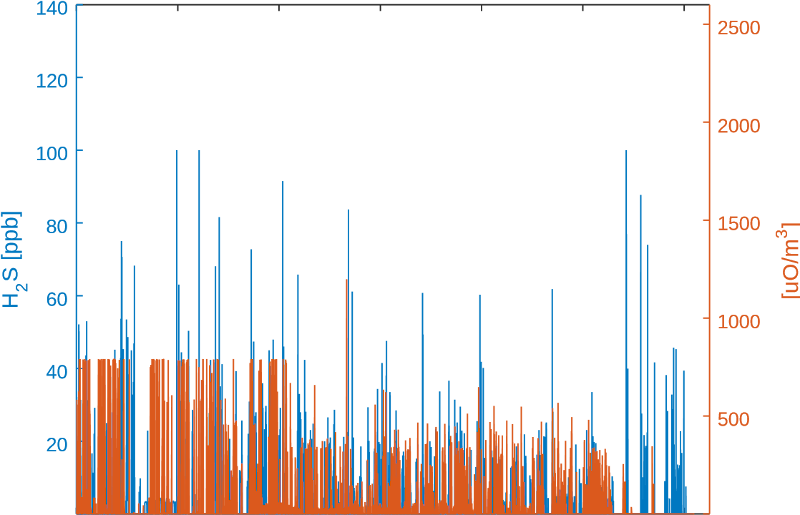
In a non-hazardous waste landfill an integrated odour monitoring system comprised with 2 IOMS, 2 H2S continuous analyser and two automatic air samplers has been operating since 2018: automatic air samplers are activated when two consecutive measurements of 20 ppb at 5 min intervals are measured by H2S continuous analyser or when overall odour emission measured by IOMS exceeded 500 ouE/m3 for more than 5 min.

   Problems with odour emissions were noticed in May-August 2019 with almost a daily automatic samplers’ activation, often correlated with complaints of population; moreover, monitoring campaigns of biogas from the landfill surface showed significant increase of surface emissions for certain zones, implying that surface and fugitive emissions form landfill biogas (LFG) collecting system could have been responsible for such odour emissions. The LFG wellfield system of is comprised of a network of 301 vertical wells in the landfill, coupled with conveyance piping for the transport of LFG to energy recovery and 3 blowerflare facilities.

   Odour impact is generally low around Waste Water Treatment Plants (WWTP) when conventional Odour Control Unit (OCU) such as chemical scrubbers or biofilters are implemented. However, for some specific WWTP processes such as sludge thermal drying releasing odorous Volatile Organic Compounds (VOC) in particular aldehydes and ketones, these conventional OCU are not effective enough to avoid odour nuisances in the environment.

   To fix this issue, we have proposed a simple and relevant two stages treatment line to treat odorous VOCs from WWTP. The first step of the treatment line consists of an enhanced water scrubber (absorption) and the second one, an Activated Carbon (AC) filter (adsorption). The enhanced water scrubber, patented by Suez and named AzurairTM Cool, uses a chiller to cool the inlet scrubber water in order to increase VOCs removal in scrubber and dehumidifie air before the second stage of AC filtration.

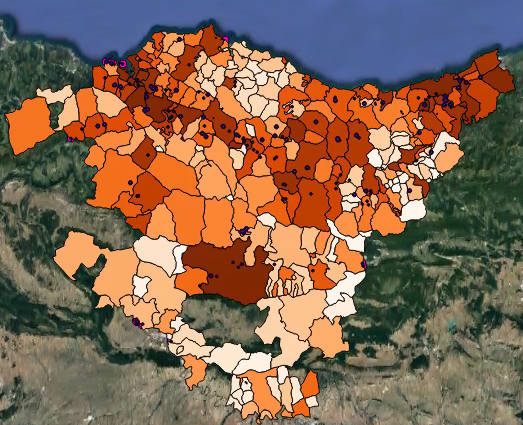
  The aim of this study was to assess the cost of not regulating odour emissions. For that we have specified a domain in the Spanish region of Euskadi situated in the North of Spain. To perform this analysis, two factors have been considered: 1) The decrease in the property value affected by odour impact and 2) The economic impact on public health.

   To assess the cost of depreciation of odour-affected properties, a list of Activities Potentially Generating Odour Impact (APGOIs) was selected in the Basque Country. With this data, buffers were generated for different areas of odour nuisance, classifying them as serious, moderate and slight. Subsequently, the number of properties with the potential to be affected by odour impact was calculated. This analysis took into account the price per m2 of each municipality in Euskadi. The results showed that the total cost of depreciation of the value of the properties affected by odour impact was 778 and 1164 million euros for areas affected by serious and moderate odour impact, respectively.


More Articles …

All the content here under Creative Commons license