Determining the emission impact of area sources (biofilters, wastewater tanks) on air quality and the environment by classic measurement techniques (i.e. static hood sampling), is currently lacking in pertaining uniform and representative emission data by being restricted in sampling area, time and safety. This creates an extra hindrance when emission rates from such sources need to be determined by the fluxwindow method, which implies measuring emission concentrations up- and downwind along different horizontal and vertical profiles of the area source.

   In an effort to improve on this matter, the possibility of using a drone equipped with an emission detection laboratory (OLFASCAN Flying Lab) to quantify emission concentrations and rates via the fluxwindow method from a sludge buffer tank was investigated. The OLFASCAN Flying Lab is equipped with several electrochemical sensors for performing air quality measurements and was attached to a DJI Matrice600 PRO RTK drone.
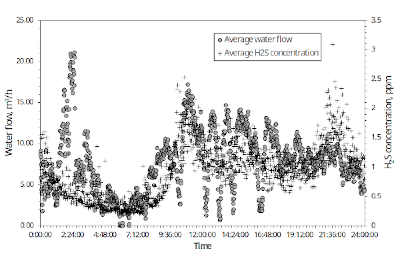
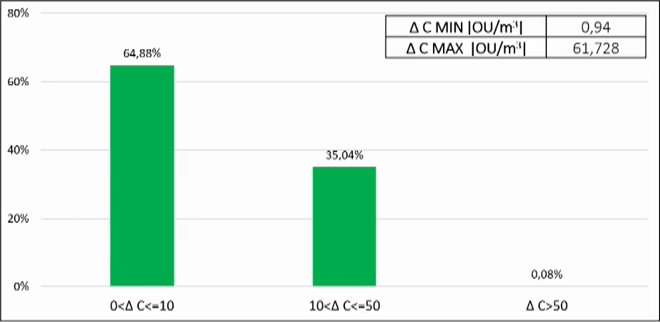
   Wastewater treatment plants (WWTPs) are fundamental for water ecosystems conservation but when they are located in the proximity of residential areas may produce odour nuisance. One of the most common odours pollutants emitted in WWTPs is hydrogen sulphide (H2S) and release to the atmosphere (in waste-waterfalls, manholes), producing a strong unpleasant smell. In this work, field olfactometry and H2S measurement enabled to identify the main odour source, located in the inlet of the WWTP.

   The maximum H2S concentration in this emission point measured was 15 ppm and odour concentration was D/T 60, enough high to produce odour nuisance despite they were produced in open atmosphere. By means of a thorough data analysis of the essential variables involved, such as wind speed, wind direction and the H2S concentrations in its role as the central pollutant, it could be shown via contrasting annual, monthly and daily patterns, that the probability to be affected for these residential areas is the highest in summer from 19:00 hours.

  Odours are typically released into the atmosphere as diffuse emissions from area and volume sources, whose detailed quantification in terms of odour emission rate is often hardly achievable by direct source sampling. Indirect methods, involving the use of micrometeorological methods in order to correlate downwind concentrations to the emission rates, are already mentioned in literature, but rarely found in real applications for the quantification of odour emissions.

   The instrumentation needed for the development of micrometeorological methods has nowadays become accessible in terms of prices and reliability, thus making the implementation of such methods to industrial applications more and more interesting.


More Articles …

All the content here under Creative Commons license