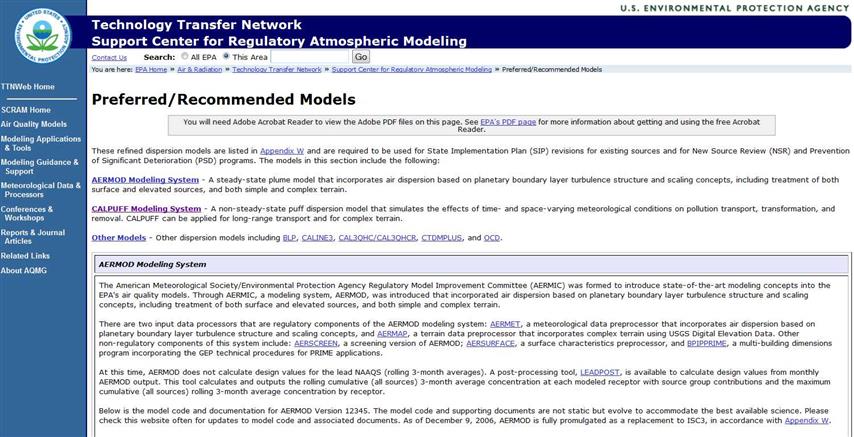
usepa calpuff 5 8s   The USEPA has approved an update of CALMET and CALPUFF from V5.8 (dated June 23, 2007) to V5.8.4 (dated July 31, 2013).

   CALPUFF is a multi-layer, multi-species non-steady-state puff dispersion model that simulates the effects of time- and space-varying meteorological conditions on pollution transport, transformation and removal.  CALPUFF can be applied on scales of tens to hundreds of kilometers.  It includes algorithms for subgrid scale effects (such as terrain impingement), as well as, longer range effects (such as pollutant removal due to wet scavenging and dry deposition, chemical transformation, and visibility effects of particulate matter concentrations).
dispersion modelling

   Modelling of the Dispersion of atmospheric pollutants is today a routine method in environmental air quality management. In the particular case of environmental odour emissions, dispersion models have become indispensable given the difficulty of obtaining a reliable value of odour concentration in immision.

The use of dispersion models helps in the prediction of the impacts on air quality from industrial emission at their sources and it is a valuable argument to propose effective control strategies.

It is also important to consider that the cost of a model usually increases with its complexity and necessary computational resources, as follows:

Eulerian model >> Lagrangian model >> Gaussian model

There is a tendency to label the quality of the models according to their complexity. This sometimes causes errors in the choice of dispersion model, since such a choice should be based on the adequacy of the model to the case study. From this point of view, a model based on the gaussian solution could be sufficient to solve a complex problem and vice versa, an eulerian model may not be adequate for a simple study. The key is to align the selection criteria and validate methods and results.

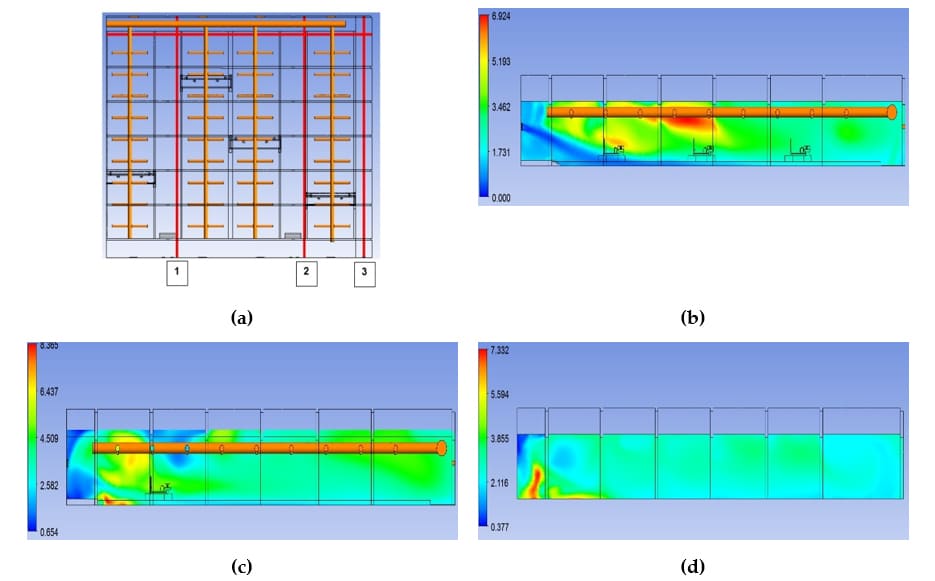
   This study evaluates a push-pull ventilation system with localized extraction designed to reduce H2S concentrations in the settling stage of a wastewater treatment plant in Santiago, Chile.

   CFD simulations and field measurements show that the existing crossed ventilation system results in H2S concentrations up to 21 mg/m³ over the water surface. The improved push-pull system effectively lowers H2S levels in the plant corridors to below 7.5 ppm, complying with Chilean regulations.

I. Polanco1, M. Rodríquez1, A. Hammad2, A. Haddad3, V. Tam4  & D. Vasco1

Department of Mechanical Engineering, University of Santiago de Chile, Santiago, Chile. ivan.polanco@usach.cl
Faculty of Built Environment, University of New South Wales, Sydney, Australia
Department of Civil Construction, Federal University of Rio de Janeiro, Rio de Janeiro, Brazil
School of Built Environment, Western Sydney University, Penrith, NSW, Australia

More Articles …

All the content here under Creative Commons license