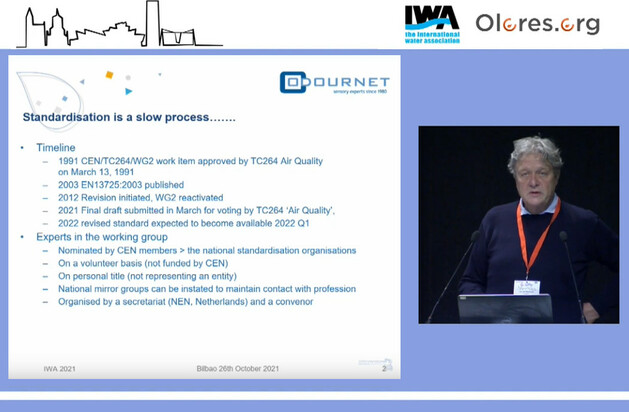
42 003   On the 20th of November 2012 the first meeting took place of Working Group 2, tasked by CEN/TC274 “Air Quality” to revise EN 13725:2003 ‘Air Quality - Determination of odour concentration by dynamic olfactometry’.

   After 8 years of work and 17 meetings, the final draft of the revised standard is finally completed and submitted on May 31st 2021 for formal vote in the CEN Technical Committee 264 “Air Quality” in 2021. This paper lists the changes that will affect the practice of olfactometry in Europe, once this standard is published as EN 13725:2021.
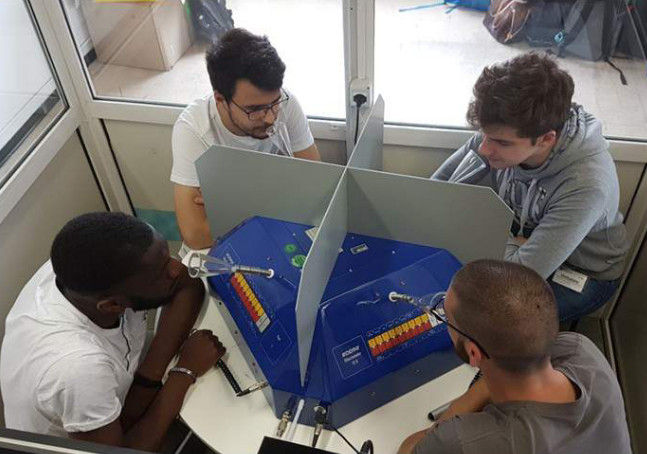
42 003   The aim of this paper is the definition of a new theoretical method for the evaluation of occupational exposure risk for workers involved in dynamic olfactometry. These workers, also called panellists, can be exposed to hazardous pollutants potentially present in odourous mixtures.

   Despite the relevance of this topic, in the regulation and the scientific literature, a standardized method to evaluate the panellists’ occupational is not provided. Therefore, this work aims to suggest practical solutions for the risk assessment of olfactometric workers. The proposed approach is based on the quantification of non-carcinogenic and carcinogenic risk for panellists’, based on the evaluation of hazard indexes (HIs) and the inhalation risks (IRs) for the odorous mixtures.

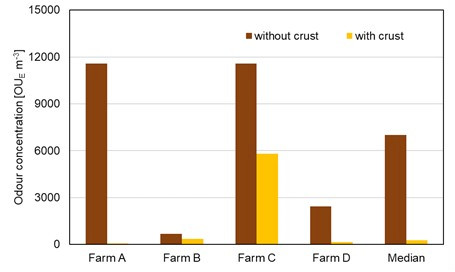
   Cattle farms consist of various spatially extended odour-emitting areas representing ground-level diffuse odour sources. These include loose-housing systems with outdoor exercise areas, the supplied diet, and storage areas for silage, slurry and solid manure. The aim of this study was to identify relevant odour sources on cattle farms and to compare the odour concentrations of individual sources, bearing in mind descriptive parameters.   

   Compared with hay and sugar beet pulp (mean: <750 OUE m−3), higher odour concentrations resulted from the cut surface of grass silage (3990 OUE m−3) and maize silage (1690 OUE m−3) in the stores as well as from the mixed ration with silage on the feed table (2955 OUE m−3). Samples from the solid floors in the cattle housing (feeding and cubicle access aisles, outdoor exercise area) and from solid manure stores showed higher odour concentrations (1485 resp. 1845 OUE m-3) than littered areas such as cubicles and deep-bedded areas (<500 OUE m−3).

More Articles …

All the content here under Creative Commons license