There is no translation available.

   There are different strategies to carry out environmental odour impact studies, such as emission studies based on the European Standard EN 13725 or immission studies based on the German Standard VDI3940. By means of these methodologies, it is possible to determine the origin of the nuisance caused by an industrial facility (or group of facilities) in its surroundings.

J. M. Juárez-Galán, A. Amo, J.V. Martínez y I. Valor
Aqualogy Medio Ambiente, C/Dracma 16-18, Polígono Industrial Las Atalayas. 03114 Alicante. Jmanuel.juarez@labaqua.com.

Keywords: EN 13725, Olfactometry, odour abatement, cost reduction.
 

sesion3_juarez01Abstract

    There are different strategies to carry out environmental odour impact studies, such as emission studies based on the European Standard EN 13725 or immission studies based on the German Standard VDI3940. By means of these methodologies, it is possible to determine the origin of the nuisance caused by an industrial facility (or group of facilities) in its surroundings. This diagnosis stage, allows to know the sources that are are truly responsible of the odour nuisance and therefore, to assess the most-effective corrective measures. Among these measures, there are several possibilities, from the increase of chimneys height to improve the dispersion conditions, to the implementation of an abatement system. Independently on the solution finally chosen, and considering the investment cost, the benefit for the company can be evaluated from two points of view. On one hand, there is a social benefit because the industrial activity is accepted by the social context since there is no negative impact. On the other hand, the information about the sources which are responsible of the odour nuisance allows to focus the economical investment to the operational units where it is required, saving money. In this paper, two case studies are presented. In both of them, due to the results obtained by an emission study based on EN 13725, several solutions have been proposed that have supposed important improvements when comparing them to the investments initially proposed without any odour study.

There is no translation available.

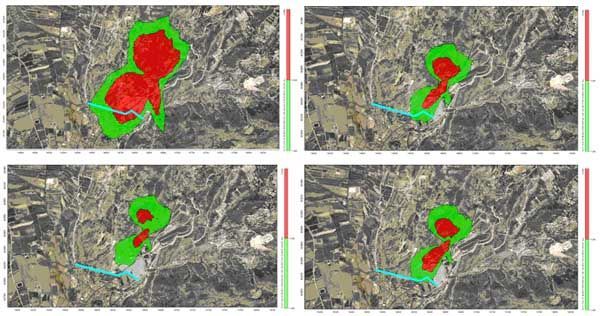
The aim of field inspections is to register the odours immediately recognized under real field conditions.

The main idea of field inspections is to estimate the degree of annoyance in a determined problematic area by means of the olfactory capacities of a group of people (or panel) specially trained and "calibrated" for this purpose. To this effect, the study area is divided in smaller assessment squares and the people of the panel is sent to the nodes of this squares at different times of the day and in a determined order to allow the most diverse conditions. Anytime a person of the panel reach a node, smells the air and take notes of odour parameters (Intensity, hedonic tone, etc.), weather conditions and some other data on site.

Contenu sponsorisé

La GC-IMS n'est plus "seulement" une technique intéressante pour les travaux sur les odeurs - elle est en train de devenir l'épine dorsale de référence pour une analyse sérieuse et défendable des odeurs dans l'environnement. Dans le monde entier, des laboratoires et des consultants de premier plan l'ajoutent discrètement à leur boîte à outils et découvrent à quel point leurs évaluations des odeurs peuvent devenir plus robustes, plus rapides et plus objectives. La GC-IMS (chromatographie en phase gazeuse - spectrométrie de mobilité ionique) offre une séparation en 2D, une sensibilité inférieure à PPBV et un matériel robuste et portable qui permet d'aller là où se trouve réellement le problème des odeurs : à la cheminée, à la frontière, dans l'usine. L'IMS fonctionnant à la pression ambiante à l'aide d'une source bêta au tritium (exemptée par l'AIEA/EURATOM, aucune licence n'est requise) et d'ions réactifs à base d'eau, vous évitez les systèmes à vide, la fragmentation et les effets de dilution associés, tout en obtenant des empreintes directes et de haute qualité des COV que vous pouvez corréler avec les données sensorielles.

Pendant des années, les unités d'odeur ont été acceptées mais souvent remises en question par les opérateurs, les régulateurs et les voisins en raison de leur manque de transparence chimique. Le GC-IMS change cette équation en mesurant les empreintes réelles des COV dans les échantillons de gaz au niveau sub-ppm avec une séparation GC+IMS orthogonale, offrant une grande sélectivité pour une large gamme de substances volatiles. Les instruments sont compacts et robustes, peuvent être intégrés dans des laboratoires mobiles ou des camionnettes avec un générateur d'azote embarqué, et n'ont besoin que d'une alimentation électrique sur site. Au lieu de discuter de la "gêne olfactive" en termes abstraits, vous pouvez présenter des tracés bidimensionnels, des pics et des empreintes digitales qui différencient clairement les sources et les conditions de fonctionnement.

Plus d'articles...

All the content here under Creative Commons license