With the new odour standard for swine facilities in Chile, Maxagro and the industry face the challenge of advancing towards sustainable production and managing community expectations.
Despite technological investments that have reduced odours by over 75%, the perception of low-level odours can still lead to complaints. Maxagro actively works with the community to improve understanding and social well-being.
E. Ellmen
Maxagro, Chile. eellmen@maxagro.cl
Competing interests: The author has declared that no competing interests exist.
Academic editor: Carlos N. Díaz.
Content quality: This paper has not been peer-reviewed.
Citation: E. Ellmen, 2024, The Odour Standard in Chile: Maxagro’s Experience and Community Expectations, ODORA24 Conference, Barakaldo, Spain, www.olores.org.
Copyright: 2025 Olores.org. Open Content Creative Commons licence. It is allowed to download, reuse, reprint, modify, distribute, and/or copy articles in Olores.org website, as long as the original authors and source are cited. No permission is required from the authors or the publishers.
ISBN: pending.
Keywords: community, swine industry, facilities, technologies.
Abstract
With the entry into force in Chile of a new odour standard for swine facilities, Maxagro and the industry face the challenge of promoting sustainable production under a new scenario that involves multiple understandings. On the one hand, the regulation provides regulatory certainty for companies, but on the other, it also creates high expectations among communities and the surrounding environment that odours could be reduced to zero.
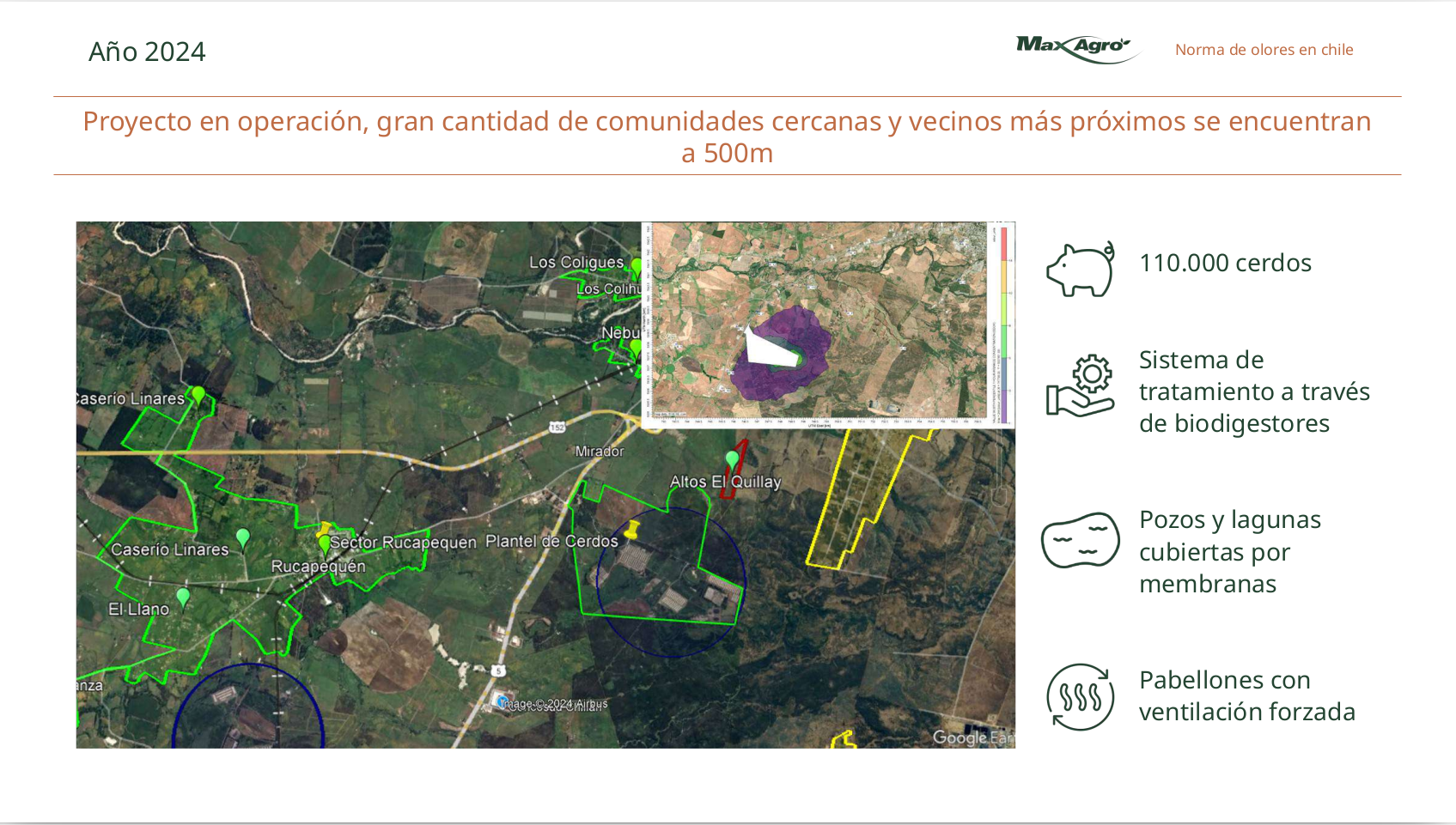
We have the example of one of our facilities, which has 30 years of history and where, over a decade ago, we began an investment plan focused on implementing various technologies that have enabled us to reduce odours by more than 75%, even as production has multiplied. Our closest neighbours are about 300 meters away and consist of around 20 houses built four years ago.
The new regulation requires large facilities like this one, which has 110,000 animals, to comply with a limit of 8 odour units (ou) at the 95th percentile, allowing the limit of 8 ou to be exceeded for up to 438 hours per year. According to the latest modelling, our facility currently exceeds 8 ou for only 78 hours per year, and 95% of the time, less than 4 ou are perceived at the nearest receptor. However, since odours in these ranges are already perceptible, they could eventually lead to complaints, despite widely complying with the regulatory limit.
At Maxagro, we are part of the community, we understand the concerns, we engage and work on projects for better understanding and joint social contribution.