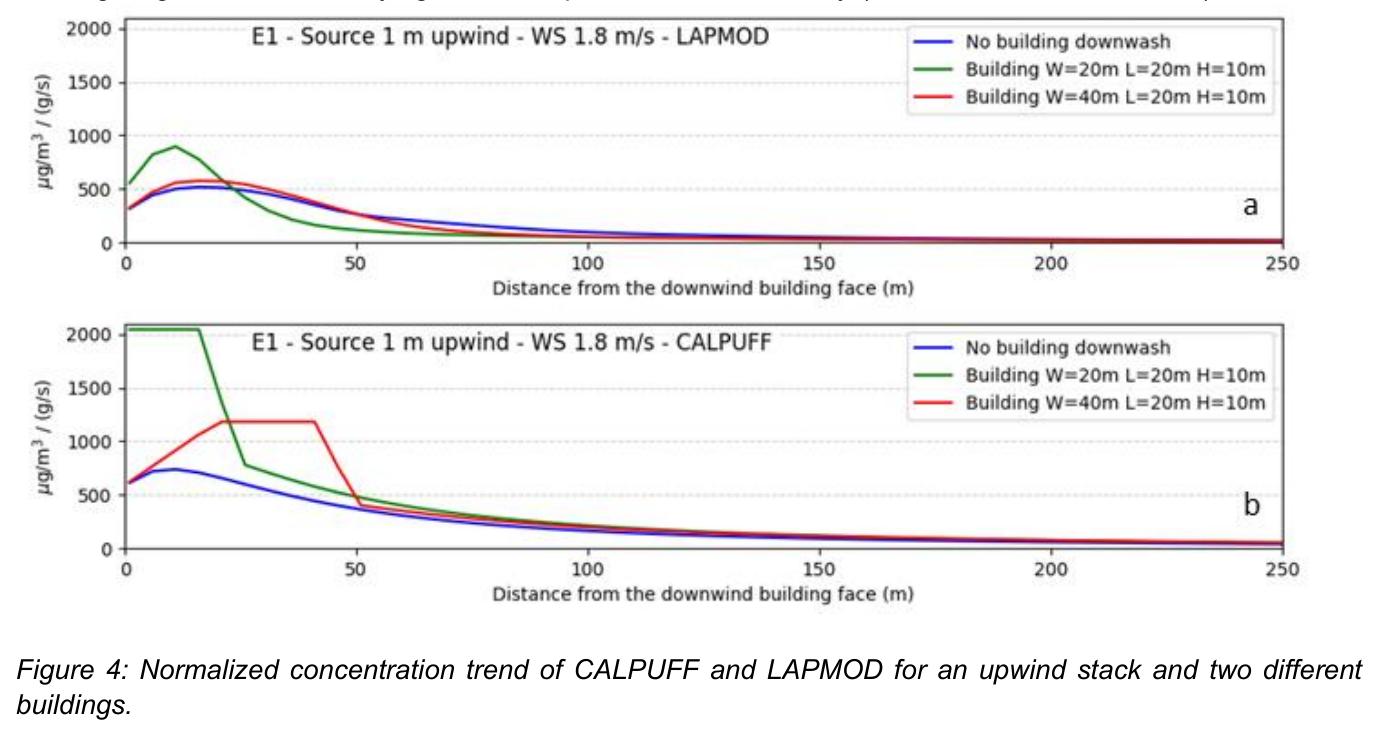
The open‑source Lagrangian particle model LAPMOD now incorporates the building downwash effect in its algorithm with PRIME2. Designed with odour in mind, it treats downwash at the particle level for point, area and volume sources, removes the need for BPIP preprocessing, and avoids the unrealistic “constant concentration” cavities that can appear with older schemes.
Odour impacts are dominated by what happens in the first few tens to hundreds of metres from the source. In this near field, buildings can force plumes downwards, enhance turbulence and create recirculation zones that strongly affect ground‑level concentrations at nearby receptors. If a dispersion model gets the building wake wrong, it can easily under‑ or over‑estimate the very concentrations that determine whether neighbours complain or not. That makes the choice of downwash scheme critical for odour assessments around wastewater treatment plants, composting facilities, food processing sites and other installations with complex layouts.
Historically, many regulatory models (for example AERMOD and CALPUFF) have used the classic PRIME (Plume Rise Model Enhancements) algorithm to represent building downwash. PRIME was a significant step forward, but wind‑tunnel and CFD studies have since shown limitations in how it represents turbulence enhancement, velocity deficit and cavity behaviour, especially for non‑rectangular or streamlined structures such as tanks and cooling towers.
PRIME2, developed by Petersen & Guerra (2018), updated the scheme to better match these data. This new algorithm introduced improved formulations for turbulence and velocity deficit in the wake, dedicated treatment of streamlined buildings and cylindrical structures, and a more physically consistent representation of the recirculation cavity. For odour modelling, where short‑range peaks and wake effects are important, PRIME2 offers a more adapted description of near‑source physics than classic PRIME.
In a new paper published in Chemical Engineering Transactions (Vol. 127, 2026), Roberto Bellasio and Roberto Bianconi have described the implementation of building downwash in LAPMOD, an open‑source Lagrangian particle model already used for odour dispersion. LAPMOD adopts PRIME2 rather than classic PRIME, aligning the model with recent wind‑tunnel and CFD evidence on wake behaviour. The downwash effect is applied to every particle moving through the wake. This includes emissions from point, area and volume sources, which are very common in odour‑emitting facilities (for example open basins, tanks, fugitive emissions from buildings).
Another nice feature is that LAPMOD reads building geometry directly, so there is no need for a separate BPIP/BPIPPRM preprocessing step to generate projected building dimensions per wind sector. This simplifies setup and reduces the risk of geometry‑related errors. Sensitivity tests show the expected behaviour: concentrations increase sharply close to the building, and the downwash effect fades as the source moves deeper into the wake, in line with physical expectations and experimental data.
The paper includes a side‑by‑side comparison with CALPUFF, which still relies on the classic PRIME scheme. The results highlight practical differences that matter for odour assessments. CALPUFF predicts notably higher concentrations within the building wake compared with LAPMOD using PRIME2. This can lead to more conservative (and potentially unrealistic) impact estimates near facilities.
CALPUFF also produces an almost uniform concentration zone in the recirculation cavity behind the building, an artifact not supported by wind‑tunnel or CFD evidence. PRIME2 in LAPMOD avoids this behaviour, giving a more realistic spatial pattern of odour exposure. For practitioners, this means that classic PRIME‑based models may overestimate peak odour concentrations in the immediate wake, while also misrepresenting how concentrations decay with distance and position relative to the building.
For odour modellers and regulators, this work provides a practical path to more realistic near‑source predictions, especially in complex industrial sites where buildings and low‑level sources control exposure.
If you found this article interesting, you might also like:
