
Home

reunion virtual At the past Conference on Environmental Odour Management hold in Madrid, the setup of an Association to gather the experiences of the members was postponed, as no objectives were defined yet.


However, it was agreed to take steps forward on this issue. Therefore and to this effect, we make a call to anyone interested on this matter for the First Virtual Meeting to be held on Wednesday 20th of March 2013 at 19:45 (GMT+01:00). The duration of the meeting will be of 1 hour.


Official language will be Spanish, however, an English review slot will be available for half an hour from 19:45 to 20:15. In this slot, several issues will be discussed in English language as well.


To access to the Meeting room. Click here.

When:  20/03/2013 19:45 - 20:45
Timezone:  (GMT+01:00) Bruselas, Copenhague, Madrid, París

Please note that it might take up to 30 seconds to access to the meeting room. Be patient!


   There is no need to install any software, it is just enough with an internet browser with Macromedia Flash Player 7 or higher. To make yourself visible, it is advisable to have a webcam and a microphone (enough if you have a laptop with both sets), we would like to see your face and to hear your comments.


If you are interested in Odour Management, join us in this virtual meeting!


If you find this article interesting, you might also be interested in these articles.


merry Christmas 2012   Olores.org would like to wish all its readers a merry Christmas and a happy new year.
   We also would like to thank to our sponsors and advertisers. The support of the companies Ecometrika and Odournet, allows us to provide Olores.org as a FREE community resources in English.

   We would like to tell you a little bit about the growing Olores.org activity as well.

   This year, Olores.org attended several conferences related with odour management, such as the Conference on Odors and Air Pollutants 15-18 April 2012 in Kentucky, USA, organized by the WEF and the NOSE2012, the International Conference on Environmental Odour Monitoring & Control, September 23-26, 2012, Palermo, Italy organized by AIDIC.

  This year has also been important as we have organized the First Conference on Odour Management in Spanish language. There are many events as the ones mentioned above related with odour control in English, but there are not many talks about this issue in Spanish, which is the second most spoken language of the world after Mandarin by number of native speakers.

  We all agree that English is the most common language to speak about cientific matters, but there was a gap that needed to be filled, therefore we decided to risk a Conference in Spanish language.

   Olores.org organized the First Conference of odours in the Environment in Madrid the 27-28 November 2012, a couple of months after the NOSE2012 that took place in Palermo, Italy.

  People from Spain, Chile and Colombia in addition with people from Portugal met in this forum and discussed about their perspective on this subject. It was also the first time that olores.org took a step forward and changed its status from a mere media comunicator into an active organization entity. The Conference was succesfully carried out thanks to the speakers and participants and we are very happy about that.

  Olores.org has already registered for the next 5th IWA Odour and Air Emissions Conference Jointly Held With 10th Conference on Biofiltration for Air Pollution Control that will take in March 4 – 7, 2013, San Francisco, California, USA. This is the first IWA Odours and Air Emissions Conference and joint Biofiltration Conference to be held in the United States and we can’t wait to see what’s next in the science of odour management.

  We hope you’ll be following along with us on this trip, but as for today, the olores.org team would like to wish you a merry Christmas and a happy new year.

  We look forward to bringing you the news in 2013.


*If you would like to become an advertiser, please contact us at +34 654 599 209.

Vortex Flow Insert   It is well known that wastewaters accumulation at the bottom of sewer drop structures may be a source of odor emissions in urban environments. H2S and other odorants are released from stagnant waters containing organic matter in solution. In addition, H2S damages concrete and metal structures, increasing maintenance costs of sewer and manholes for municipalities.

Current liquid phase odour control methods include injection of various chemicals such as ferrous sulphate, calcium nitrate or hydrogen peroxide into the sewage flow. Ozonization is another way of controlling odour in the stream.

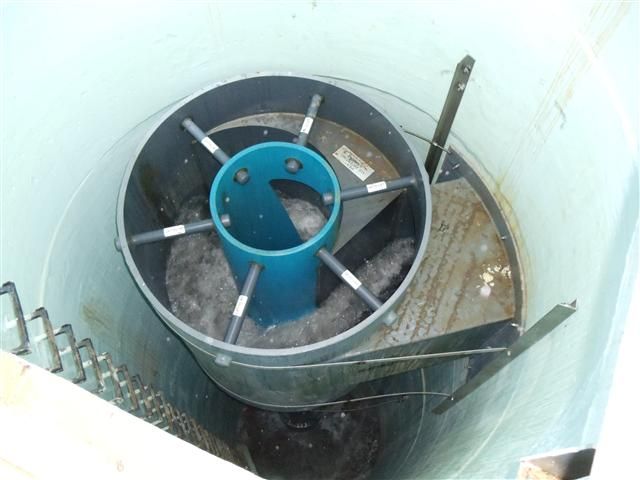
The Vortex Flow Insert is a specially engineered drop structure that uses the kinetic energy of falling wastewater to eliminate odour discharges from municipal manholes and pumping stations.

Incoming sewage is accelerated to supercritical flow conditions in the upper vortex form that has an increased slope. As the flow is accelerated, it flows around a swirl of decreasing radius, thus generating a centrifugal force.

The sewage flow proceeds to a much smaller diameter drop pipe, where it continues to spin and drop at the same time. This creates a whirlpool effect, forming an air core down the centre of the drop pipe.

This whirlpool or vortex effect creates a slightly lower pressure in the air core, creating a down draft that draws odorous gases down to the bottom of the manhole. The H2S and other gases are entrained back into the sewage in the specially designed energy dissipating pool.

Because of the vigorous aeration and mixing that occurs in the energy dissipating pool, the dissolved oxygen content of the sewage is drastically increased, thus oxidizing the H2S gas.

According to the Maker, for the Vortex Flow Insert to be effective, a drop depth of at least one metre is required; however, a drop of three metres or more is considered optimal.

While the Vortex Flow Insert typically has a lower capital cost than most chemical injection systems, the real savings come when considering the annual chemical costs. Based on a flow of around 4 000 m3/day, with a concentration of 5 mg/l of dissolved sulphide, annual chemical costs could range between €23 000 and €30 000 annually (Richard St-Aubin, Environmental Science & Engineering - September 2003).

In areas where the total drop may be less than adequate for complete odour attenuation, the Vortex Flow Insert can work in tandem with traditional chemical injection to reduce chemical costs.

More information here.


If you find this article interesting, you might be also interested in these articles.


More Articles …